Can insulation materials be reused without compromising building performance? A large-scale testing campaign carried out within the Start2Reuse Insulation project provides encouraging answers.
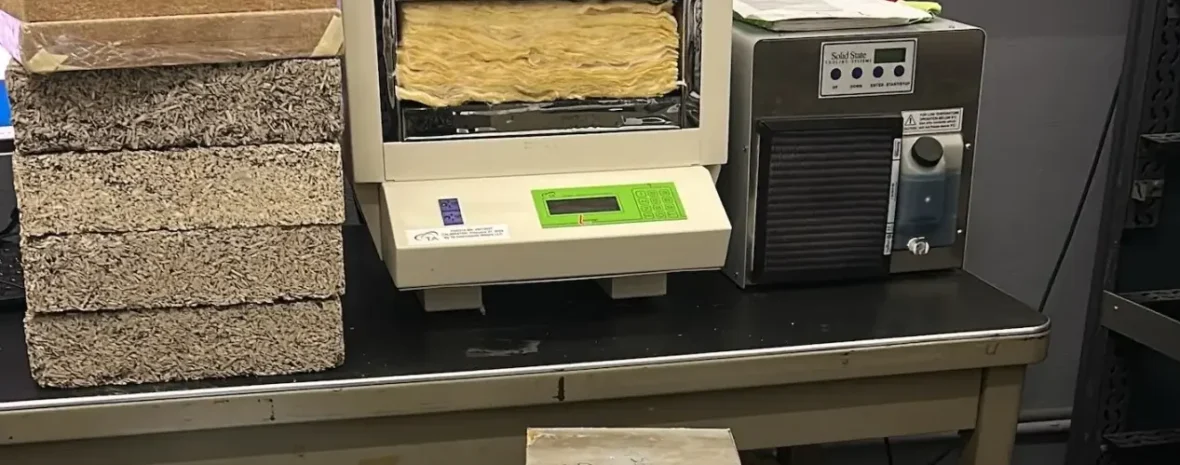
More than 1,200 laboratory tests were conducted on insulation materials recovered from 67 construction sites. The aim was to better understand the thermal and technical performance of reused insulation materials and to provide reliable data for professionals interested in incorporating them into their projects.
Thermal performance confirmed
One of the project’s key findings concerns thermal performance.
The results show that the thermal conductivity (λ) of reused insulation materials is consistently better than the default value commonly used in EPB energy performance calculations. Depending on the insulation type, the average improvement ranges between 26% and 29%.
These findings help address a recurring question surrounding reuse: can insulation materials still perform effectively after a first life cycle? According to the research, the answer is often yes.
Understanding the limits of each material
However, not all insulation materials behave in the same way.
Their technical performance can be influenced by factors such as moisture content, density and overall condition. Each material type has its own characteristics and requires a specific assessment approach.
The challenge is therefore not whether reuse is possible, but rather how to evaluate materials correctly and identify the most suitable reuse applications.
A practical tool for the sector
To support professionals, the project partners developed reuse-insulation.com.
Based on aggregated test data, the platform helps estimate the performance of reused insulation materials and provides recommendations tailored to the material under consideration.
👉 Discover the tool: www.reuse-insulation.com
Scaling up reuse
The project demonstrates that reused insulation materials can be a viable solution in many situations. However, scaling up these practices will require shared assessment methods, improved traceability and stronger collaboration across the entire construction value chain.
These elements are essential for making circular construction a mainstream practice.
A collaborative research effort
The 1,200 tests were carried out as part of the Start2Reuse Insulation project, involving Buildwise, Ghent University and Odisee University of Applied Sciences.
Beyond generating valuable research data, the project provides practical tools that can help professionals make informed decisions when considering reused insulation materials.