| In 2006, the Brussels Region created the ecobuild cluster based on a simple intuition: Brussels’ built environment would have to evolve to respond to climate challenges and help make Brussels a more sustainable, more resource-efficient and low-carbon city. This transformation would not happen only through new construction, but above all through the renovation, adaptation and reinvention of what already exists. At the time, it was a bet. Twenty years later, it has become self-evident. Energy performance, circular economy, material reuse, building reversibility: the sector’s major shifts have rarely imposed themselves all at once. They have emerged through concrete issues, project after project, gradually giving rise to new professions, new business models and new value chains. In 2026, the conversion of offices fits into this same logic. Since remote working became widespread, part of the tertiary building stock has lost its original function. In Brussels, an administrative, European and economic capital where offices occupy a major place in the urban landscape, the issue has become impossible to ignore. But this topic is not only a matter of urban planning. It also directly concerns entrepreneurship. Transforming an office building into housing, mixed-use spaces, productive spaces or collective facilities means mobilising architects, engineering firms, (de)construction companies, reuse specialists, real estate developers, energy actors, designers, project managers and social innovation stakeholders. It means creating activity around a very concrete regional need. This is precisely where hub.brussels has a role to play: identifying these shifts, supporting the companies that seize them and helping make Brussels a place where economic responses to urban transitions are invented. Because behind every converted building, there are also Brussels-based entrepreneurs who experiment, adapt their professions and create value. The conversion of offices is therefore not only a response to a changing city. It is also an opportunity for a more sustainable, more circular and more inventive Brussels economy, one that continues to innovate and inspire beyond our borders. Emmanuel Malfeyt – Coordinator of the ecobuild Cluster |
In Brussels, office vacancy is rising again — to around 8% — while housing demand remains under pressure. Between myths and realpolitik, conversion is gaining ground: more than 100,000 m² are redirected towards other uses every year, and emblematic cases are multiplying. One key question remains: how can it become a lever for affordability? Anders Böhlke, researcher at UCLouvain and member of the scientific committee of the BSI–citydev.brussels chair, and Aline Branders, associate architect at A2M, outline a few possible answers.
A city shaped by offices
“Brussels has a fairly considerable proportion of offices in relation to the size of its population,” recalls Anders Böhlke. With nearly 13 million m² of office space for around 1.2 million inhabitants, the capital has one of the highest ratios in Europe. This situation is inherited from the presence of the European institutions and from Belgium’s institutional complexity.
After decades of continuous growth, however, the trend has reversed. “We reached a peak around 2011-2012. Since then, the stock has been decreasing,” observes the office conversion specialist. Between the financial crisis, remote working, rising energy costs and changing occupier expectations, demand for tertiary floor space has contracted.
As a result, between 8 and 9% of the stock is currently vacant, representing around one million square metres. This vacancy mainly concerns the oldest buildings. “Two thirds of the empty buildings in Brussels today are more than fifteen years old,” Anders Böhlke points out.
In response to this situation, conversion has become a phenomenon in its own right. It is nothing new: the first projects date back to the early 1990s. Today, according to Anders Böhlke, one in five homes in Brussels is produced in former office buildings.
An obvious solution… on the surface
At first glance, the equation seems simple: empty offices on one side, a housing shortage on the other. “When I started working on the topic, I thought: this is absurd. We have more than one million square metres of empty offices and enormous housing needs,” says Anders Böhlke. Yet twenty years later, the observation remains the same: “It seems obvious, but it is not that easy, for a whole range of technical, regulatory, legal and economic reasons.”
Conversion is not simply a matter of replacing workstations with apartments. The two programmes follow radically different spatial logics.
The constraints of the existing building
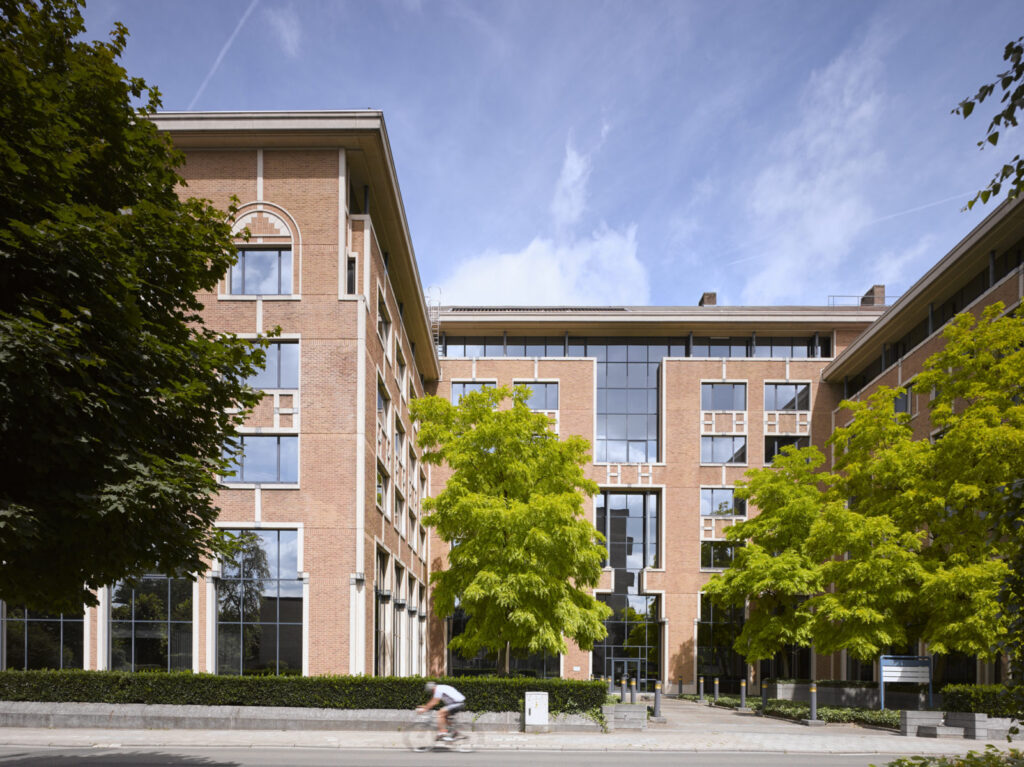
The depth of floor plates is often the first obstacle. Office buildings frequently have depths of 15 to 18 metres, which are not very compatible with the requirements of contemporary housing.
“We always try to favour dual orientation,” explains Aline Branders. “It is interesting for natural light, ventilation, limiting overheating risks and improving comfort.” When this configuration is not possible, architects have to imagine other solutions: openings, patios, terraces or new circulation routes.
“It is agile design,” she sums up. “We think from the structural constraints to find suitable solutions.”
Circulation cores also represent a major challenge. “To create housing, new staircase and lift cores often have to be created,” the architect continues. These are heavy interventions that have a direct impact on the project budget.
Added to this is an often overlooked economic reality. As Anders Böhlke points out, 100 m² of office space does not automatically become 100 m² of housing. Part of the surface area is absorbed by circulation, technical shafts and shared spaces. The real estate yield is mechanically reduced.
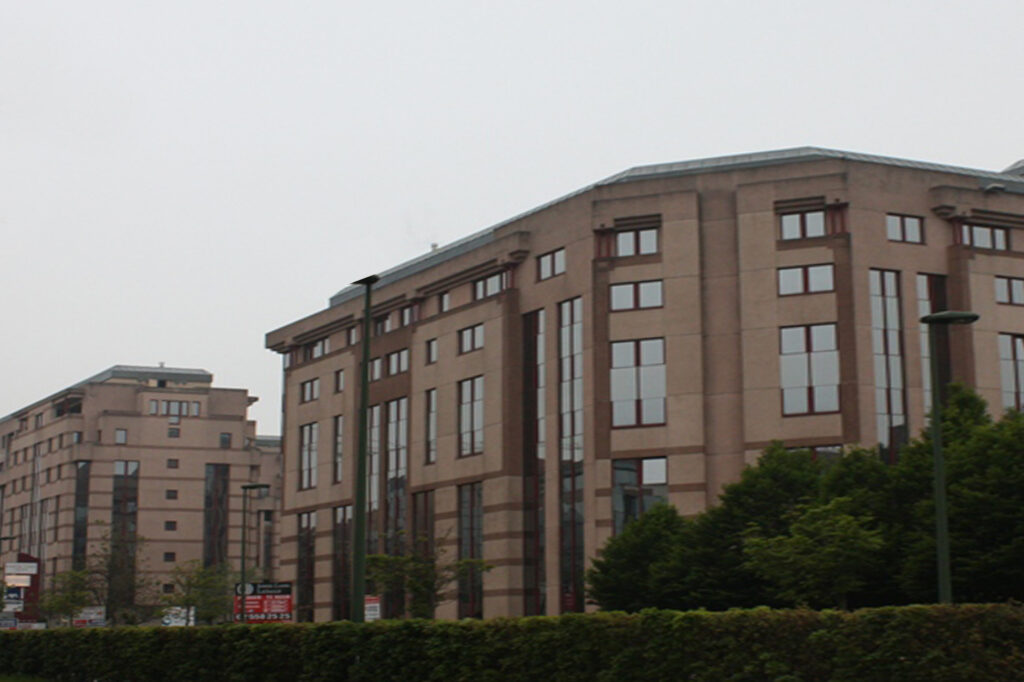
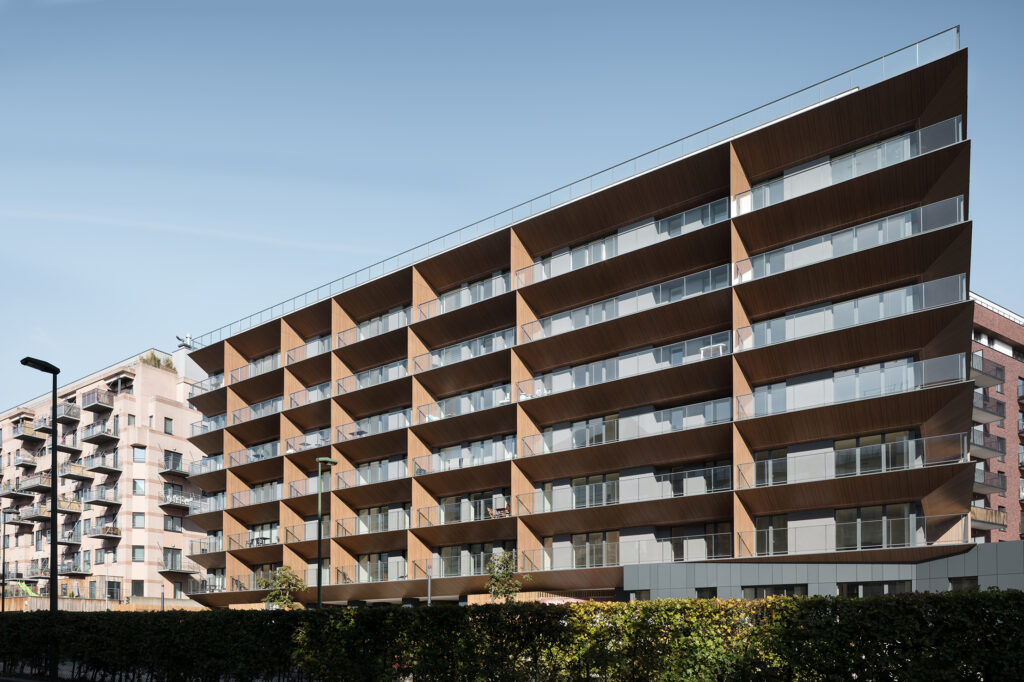
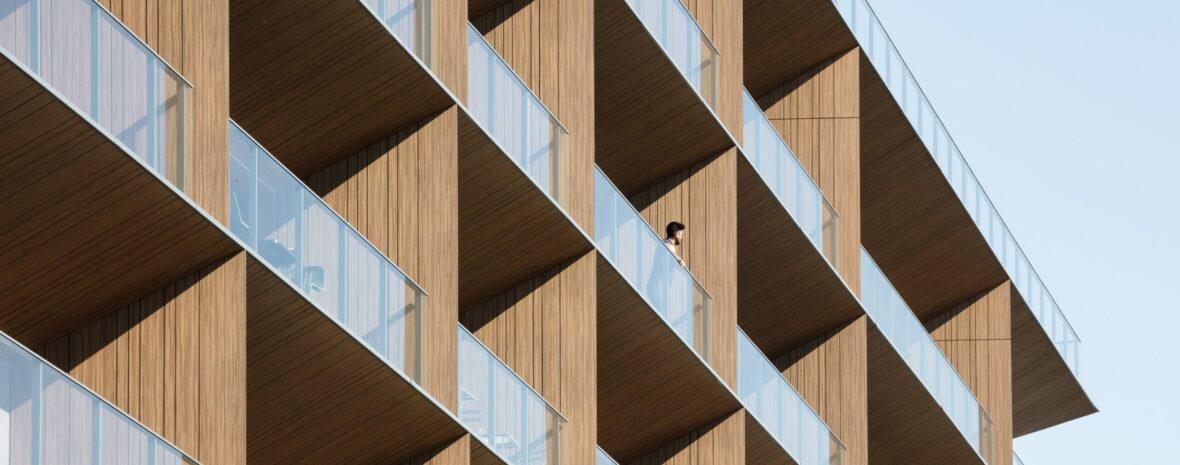
A Woluwé Saint-Lambert, le projet ‘Les Balcons’ s’inscrit dans le processus de réaffectation d’immeubles inoccupés, en vue de répondre aux besoins croissants en logements et au développement raisonné du tissu urbain à Bruxelles. Le maître d’ouvrage; le promoteur bege Oryx Projects, en a confié la conception au bureau d’architecture bruxellois A2M.
Spatial quality as an opportunity
For Aline Branders, conversion projects sometimes suffer from an overly normative reading. “The quality of a user’s experience in a space cannot be translated only into surface areas in an Excel spreadsheet.”
Existing buildings often offer qualities that are difficult to reproduce today: generous ceiling heights, noble materials, exposed structures or atypical volumes. “Sometimes you find floors, terrazzo or natural stone that no developer could afford in a new affordable housing project,” she notes.
Anders Böhlke shares this view: “It is just as qualitative to try to preserve as much as possible of what already exists rather than systematically starting from scratch.”
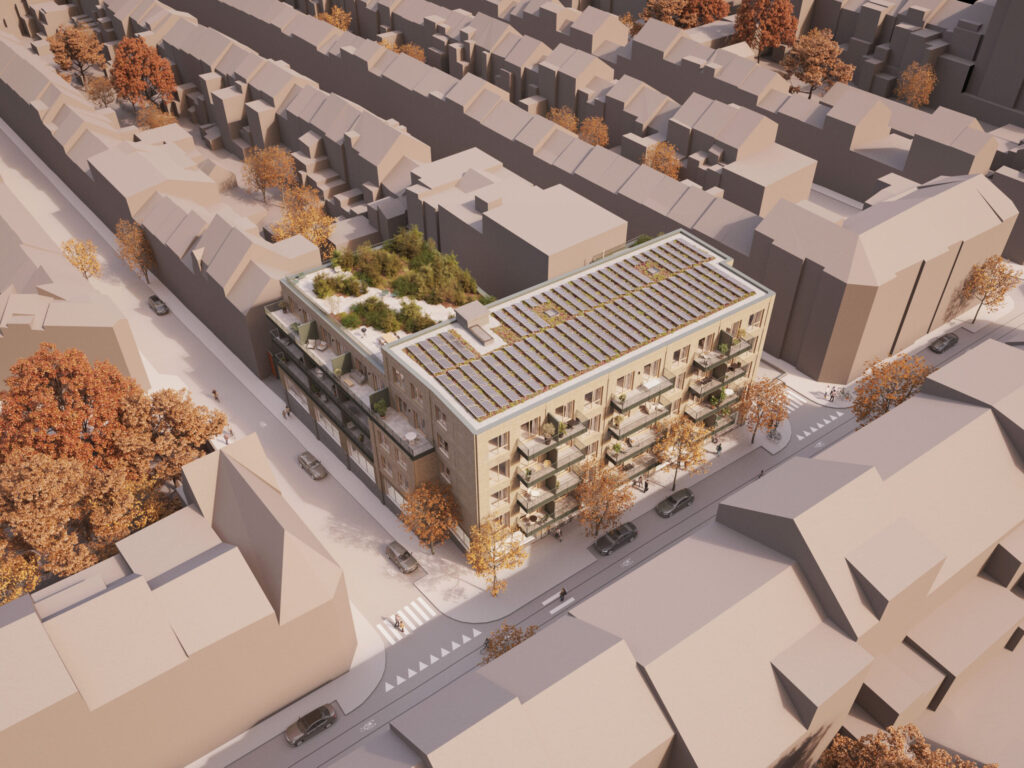
This approach is already visible in several Brussels projects. The Antarès project, developed with Inclusio in the Marcel Thiry district, notably used external walkways to make it possible to transform a tertiary building into housing.
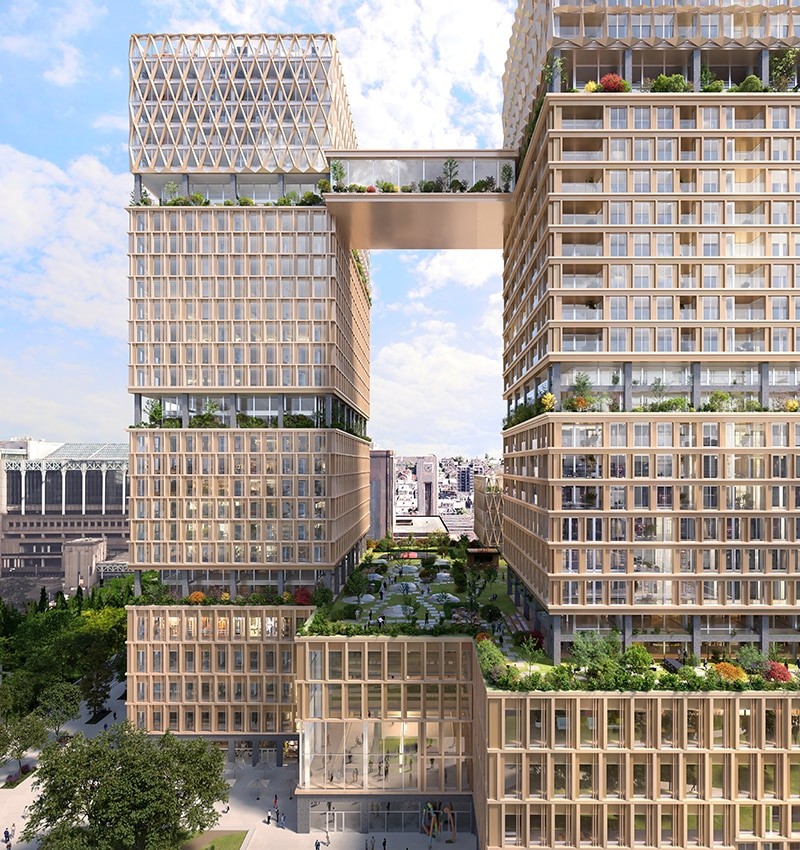
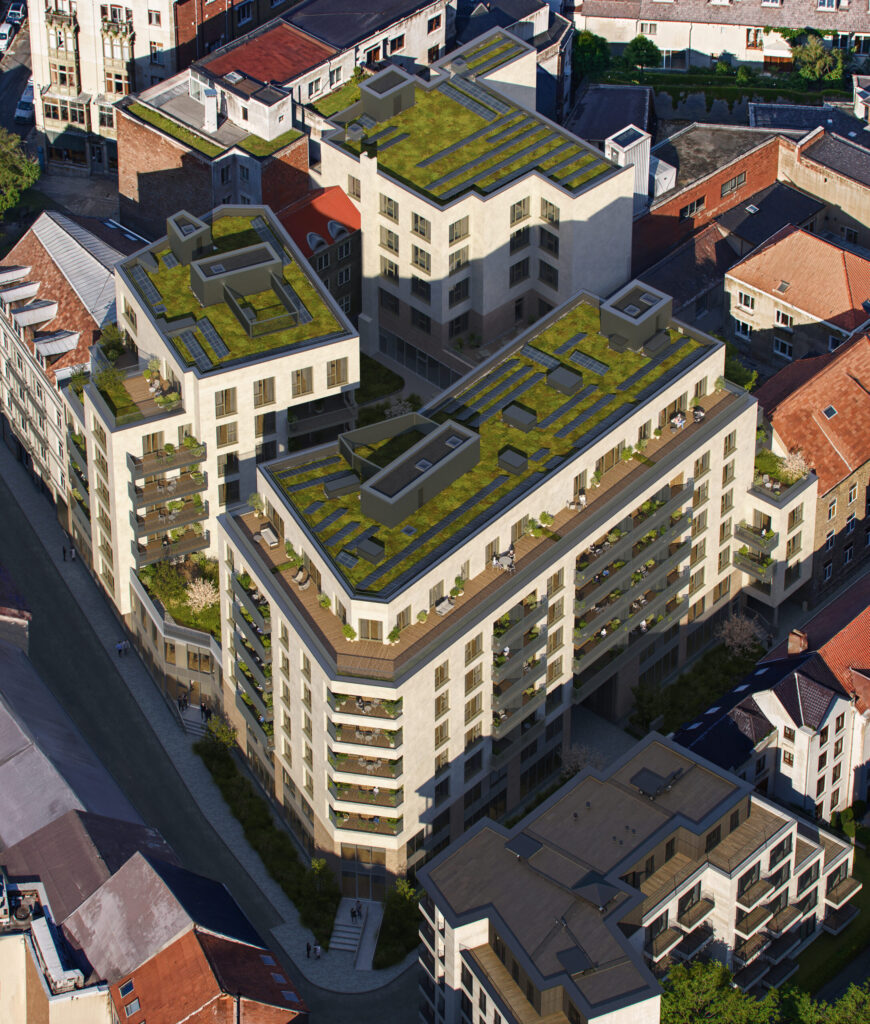
The U Square project, on the site of the former Ixelles barracks, illustrates the value of a more comprehensive approach. Student housing, regulated housing, offices, university facilities and collective spaces coexist within the same ensemble. “This functional mix enriches uses and also makes it possible to place the right programme in the right place,” Aline Branders sums up.
This flexibility appears all the more important because each building is a specific case. Some structures naturally lend themselves to conversion. Others require such heavy interventions that partial demolition may sometimes prove more relevant, particularly when major extensions are being considered.
Why affordability remains the exception
The main difficulty remains economic. “Public actors such as citydev.brussels are still among the few players able to develop affordable housing from converted offices,” Aline Branders observes.
The cost of transformation remains high. Above all, the value of office space sometimes remains higher than that of housing, particularly in central districts. “If we look at all the conversion projects carried out since the late 1990s, those that have resulted in affordable housing can be counted on one hand,” Anders Böhlke emphasises.
The tax issue further reinforces this difficulty. While some tertiary activities can recover VAT on their investments, residential operations remain subject to a less favourable regime.
In several central districts, the value of office space remains higher than that of housing. This is notably the case in parts of the European district, where public authorities are now trying to introduce greater functional mix through City Forward. This large-scale programme provides for the gradual transformation of part of the European Commission’s real estate portfolio in order to integrate more housing and collective facilities. “Today, in the European district, only 6% is housing. We are starting from far behind,” recalls Anders Böhlke.
Towards more suitable regulation?
For both experts, the current rules were mainly designed for new construction. “Today, however, the main issue is renovation,” Aline Branders recalls. When transforming an existing building, certain requirements relating to surface areas, natural lighting or energy performance may be more difficult to achieve.
Anders Böhlke also argues for a differentiated approach: “Logically, we should have different requirements for new buildings than for existing ones if we want to renovate more efficiently.”
The same observation applies to procedures. “The very principle of conversion is that you have to remain flexible,” Aline Branders insists. Yet projects often have to be fixed very early on, while on-site discoveries regularly require adaptations.
The two specialists also point to the need for more targeted financial incentives: adapted taxation, administrative simplification, support for conversion or mechanisms that explicitly encourage the production of affordable housing.
Reuse: an investment in local employment
Beyond carbon and resource savings, conversions offer an often underestimated advantage: their impact on local employment. “As soon as you are dealing with conversion and reuse, there is a transfer of value,” explains Aline Branders. “Part of the budget that would have been spent on buying new materials is reinvested in labour.”
Selective deconstruction, material recovery, adaptation of existing structures or restoration of heritage elements require more human labour than the implementation of standardised solutions.
For cities, this aspect represents an important economic lever. It supports craftspeople, local businesses and sometimes even socio-professional integration programmes.
The U Square construction site provides a concrete illustration of this. Part of the bricks recovered on the site was cleaned and prepared for reuse, notably thanks to social economy structures.
“We see the building as a material bank,” Aline Branders sums up. “The question is what we can reuse before consuming new resources.”
Brussels expertise to be valued
Despite these difficulties, Brussels now has recognised expertise in conversion, reuse and renovation. “We have a real culture of renovation,” says Aline Branders. “Many countries are not as advanced in reuse and circularity.”
For Anders Böhlke, the challenge now is to move from a logic of exemplary projects to a genuine urban strategy: “What is needed is a more proactive, more operational and more ambitious vision.”
Office conversion will not solve the housing crisis on its own. But in a region where one in five homes already comes from former office buildings, it increasingly appears to be an essential lever for building the city within the city, preserving existing resources and accelerating the urban transition.