Renovating a house involves more than just replacing a roof or applying plaster.
It also means rethinking the entire building envelope, anticipating the connections between elements and choosing coherent solutions that improve living comfort.
Natural insulation: an effective, sustainable choice
Cellulose and wood fibre play a key role in how we insulate and offer numerous advantages. Here are the main ones:
Incomparable summer comfort
These materials absorb and then release heat slowly thanks to their high degree of inertia.
This phase shifting significantly limits overheating in summer, which is a major benefit in attic rooms.
Heavier weight: a demanding advantage
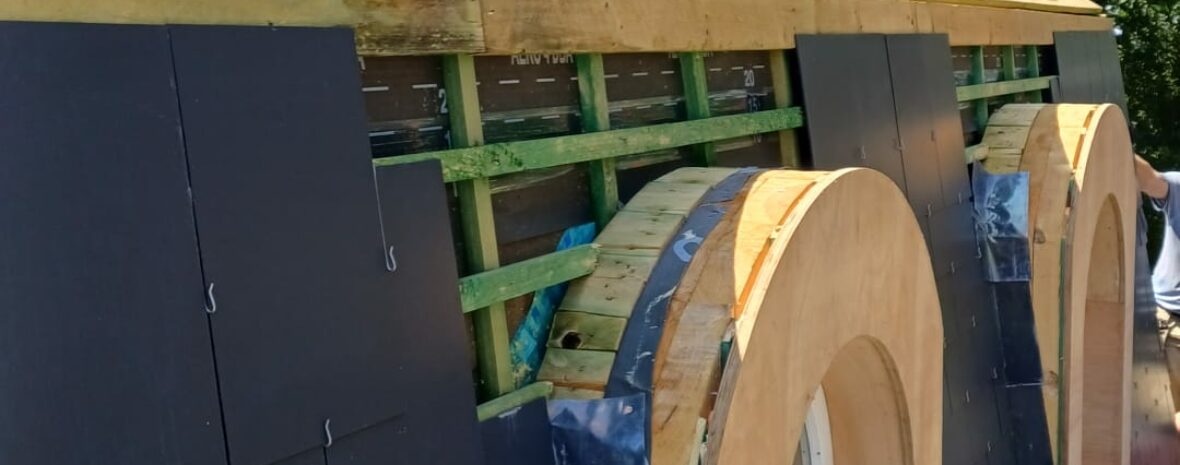
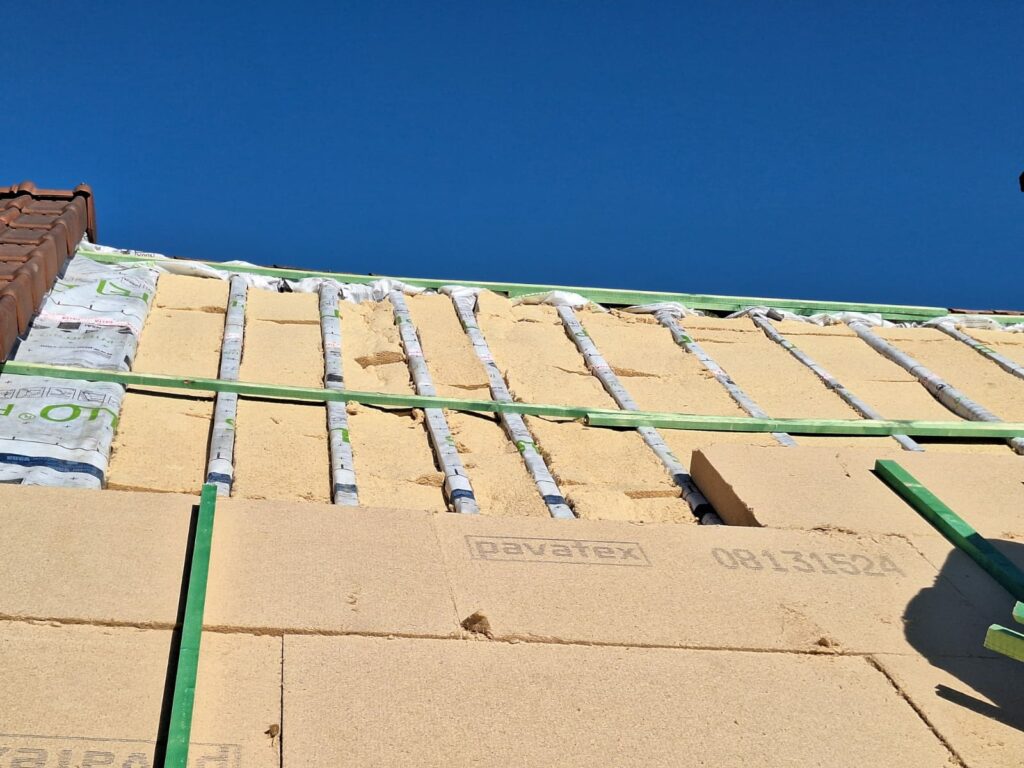
They are dense and heavy, offering excellent comfort but sometimes requiring structural adjustments. On roofs, it is not uncommon to have to reinforce rafters and/or roof purlins. A second consequence of this considerable weight is that more labour is required to install wood fibre panels. The fact that it takes two people to handle the panels and cut them using motorised tools explains why the overall price is generally 20 to 30% more, in addition to the slightly higher supply price compared to conventional materials.

Breathable, healthy materials
They are vapour-permeable and allow walls to “breathe”, stabilise indoor humidity and help to improve air quality. They are also made from renewable or recycled resources, with a significantly lower carbon footprint than petrochemical insulation materials.
A comprehensive renovation, in the correct order
A well-renovated house is not the result of a series of “jobs” carried out one after the other.
It is a logical and well-thought-out sequence, in which each step prepares for the next. Considering the building envelope as a whole is the best way to avoid thermal bridges, manage humidity correctly and ensure a durable, comfortable result.
1. Start with the facing brick
Should the facing brick be kept or removed? This choice (or necessity, sometimes) determines the possible insulation thickness, the length of the window sills to be ordered, the shape of the cornice to be made, and the final aesthetic. Insulating without taking precautions may be ineffective if there is a ventilated air gap behind the brick. Removing the brick is sometimes essential if damp is present. Insulating above the façade without addressing the cause of the damp could worsen the existing situation. So this step is not just a detail: it shapes the entire rest of the project!
2. The roof: plan the future façade now
When a roof requires renovation, it is best to renovate it before insulating the façade. This avoids expensive corrections once the façade is complete.
For external insulation (sarking), the panels usually add a thickness of 15 to 20 cm to the rafters. Therefore, the cornice must often be adapted to cover the future insulated façade and ensure the continuity of the building envelope’s insulation. It should be deep enough to completely cover the upper surface of the future façade insulation.
In houses with gables, it is advisable to “extend” the roof above the gable.
This small act allows the façade insulation to be covered with a roof overhang, which is more attractive and more effective than zinc or aluminium profiles.
Removing unused chimneys during this phase is a real option, as they act as vertical thermal bridges. When working on sarking, it is possible to remove them cleanly, use the scaffolding and replace them with modern, insulated ducts if they are still in use.
If the roof covering and underlay are in good condition, and the structure is accessible from inside the house, internal insulation can be used and placed between and under the rafters. The cornice is therefore not affected by the roof renovation. It is always important to ensure that the overhang is big enough to cover any future façade insulation.
When insulating from the interior, it is often necessary to raise the rafters from the inside to insert the insulation and keep it in place. Wood wool and cellulose are suitable solutions in this specific case. It should be noted, however, that this solution reduces the headroom in the attic by 10 to 15 cm, although it retains the existing roof covering, thus reducing costs. A Fermacell board finish can then be added to the structure to create a finished, attractive ceiling.
3. Green platforms and roofs
If a green roof is planned, it must be incorporated from the outset, as it will often require structural reinforcement, the raising of the acroteria around the edge of the flat roof, the use of an “anti-root” waterproofing membrane and appropriate drainage.
When insulating a platform, it is advisable to extend the insulation to the façade and then seal it with EPDM. This extension provides a thermal bridge-free connection with the future façade insulation. This is why platforms must always be insulated before the façade.
There are few natural insulation solutions on platforms under a vapour-proof seal. If the project aims to be “100% natural”, the use of cork, the only bio-based insulation compatible with an EPDM membrane, is a good option. Its stability and durability make it an ideal solution, but it is significantly more expensive.
4. Choose your ventilation system before ordering the frames
This point is often misunderstood, but it is crucial as the choice of ventilation system directly influences whether there are vents in the frames and the number and layout of the ventilation ducts in the house (aesthetic and technical).
Understand the phenomenon
After insulation, the walls of an “old” house are warmer and more airtight than before. Water vapour, which is always present in the home, diffuses less towards the exterior and so concentrates in the last cold areas, such as lintels, thresholds, corners with adjoining walls and window returns.
These points become the famous thermal bridges that must be avoided, while keeping the cost of addressing them reasonable. It can sometimes be very expensive to fix a thermal bridge. In renovations, common sense is often needed to stay within reasonable budgets.
Decision to be made now
A C+ system requires vents integrated into the frames. They must be planned before ordering the frames. Extraction is then motorised, and fresh air enters through the vents in the frames. However, it is also possible to shorten a window and add a vent into it. This solution is often less aesthetic than a vent above the frame.
A dual-flow system (motorised supply and extraction), on the other hand, does not require this. It can be installed later, with no constraints on the frame.

5. Replace the frames before insulating the façade
To achieve an effective façade, it is preferable to replace the frames before installing external insulation. One option is to place them further outwards, which allows better continuity with the insulation.
The practical consequence of this is that more finishing work needs to be done on the window frames inside the house. On the outside, however, the detail with the rendering on insulation will be simpler, due to the absence of corner pieces, giving a more elegant and discreet finish.
If the frames are replaced after the façade, there is rarely more than 2 – 3 cm available for insulation. It is sometimes possible to cut back the reveals to recover up to 5 cm. However, it is rarely possible to cut anything at the lintel level. In this case, a thermal bridge will remain.
Please also note that the depth of the thresholds to be ordered must be determined at this stage, as it depends on the position of the frames in the façade, the thickness of the façade insulation to be applied and the possible removal of the facing brick.
6. Insulate the façade with wood fibre (or EPS)
Wood fibre is the preferred solution, as it is breathable, high-performing in summer thanks to its inertia and ideal for attractive and sustainable rendering. When the context requires it, EPS systems are combined, although the same attention is paid to the quality of execution.
7. Install the vents
Depending on the choice made in point 4 with a C+ system, the frames are supplied with integrated vents. The mechanical ventilation unit can be installed. Air transfer grilles are required in certain doors to ensure the ventilation of the different rooms.
A D (dual flow) system can be installed at different times, as it does not require any modifications of the frames.
In all cases, ventilation ensures healthy, dry and comfortable indoor air, which is essential in an efficient home.
In conclusion
Renovating the envelope of a house first and foremost requires a comprehensive vision.
Roof, façades, frames, ventilation, platforms: each element influences the others and must be designed in a coherent order.
By prioritising sustainable materials, well-thought-out construction solutions and careful planning of technical details, renovation becomes much more than an energy upgrade. It improves comfort, indoor air quality and sustainability, while reducing expensive corrective measures.
Renovating “differently” means taking the time to understand the existing building, adapting solutions to its reality and making the right choices, both technically and environmentally. It is a demanding approach, but essential for truly effective and sustainable renovations.
An article written by CC Autrement