An Intense Week for Brussels, Between International Visibility, Local Cooperation and Structuring Choices
Each year, MIPIM represents a key moment for urban and real‑estate stakeholders. For Brussels, this concentrated week in Cannes is both an international showcase, an accelerator of Belgian‑Belgian connections, and a space for exchanging ideas around the major contemporary urban challenges.
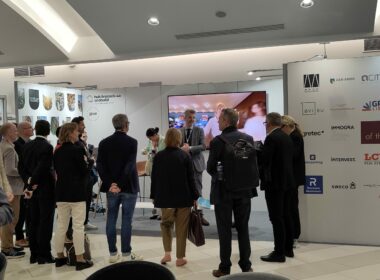
In 2026, ecobuild.brussels was present alongside hub.brussels, with Mister Emma from Archiurbain as a stand partner. The ambition was clear: to highlight Brussels expertise, foster in‑depth discussions — on affordable housing, the low‑carbon transition, and the transformation of the existing building stock — and open dialogue, without ever promoting ready‑made solutions.
Highlights of the Week
Tuesday – Creation, Architecture and Political Message
The week began with a series of complementary formats:
- Member pitches: Sunsoak Design and A2M Architects illustrated the diversity of Brussels approaches, combining innovation, pragmatism and architectural ambition.
- Screening of the film Beyond the Pavilion, produced by Mister Emma.
Beyond the Pavilion explores the journeys of five Belgian architects who brought national creativity to the international stage through the design of national pavilions for major exhibitions. The film sketches an engaged portrait of contemporary Belgian architecture, at the crossroads of sustainability, innovation and reflection on the meaning of building today. - Opening evening of the Belgian Pavilion, in the presence of the Minister‑President of the Brussels‑Capital Region, Boris Dilliès, and Secretary of State Audrey Henry, responsible for Spatial Planning, Urban Development, Public Cleanliness and Energy.
The Minister‑President recalled the importance of high‑quality architecture as a lever for attractiveness and social cohesion, while also addressing with clarity the budgetary challenges facing the Region. He highlighted the need to reform certain bodies and procedures in order to enable real‑estate stakeholders to work more efficiently in the years ahead.
Wednesday – Brussels Leading the Low‑Carbon Transition
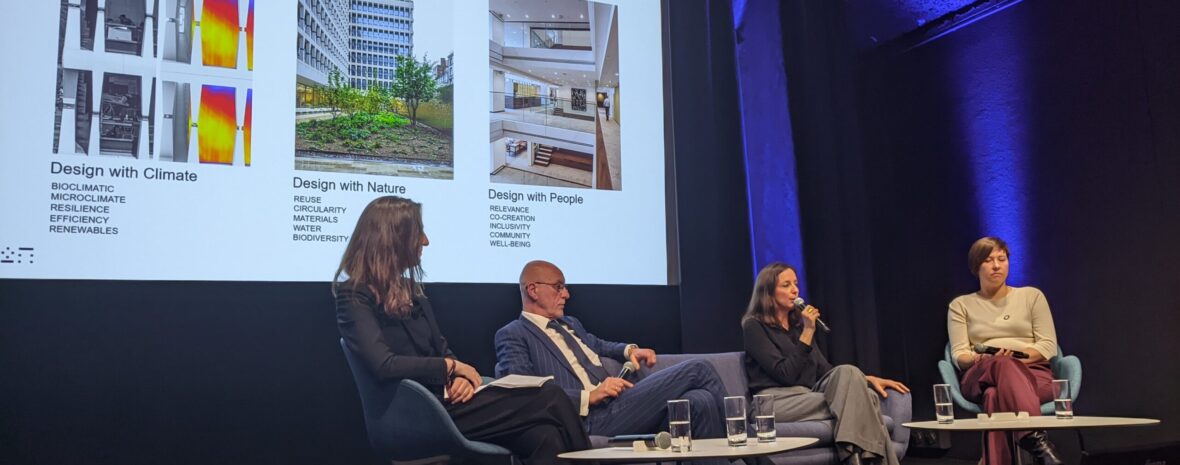
This round table brought together the Bouwmeester Maître Architecte, Befimmo, A2M Architects and Sweco around a shared observation:
the low‑carbon transition can no longer be considered an add‑on, but must become a structuring decision‑making framework, starting from the earliest project phases.
Discussions notably highlighted:
- the major impact of preserving and transforming the existing building stock as a priority lever for carbon reduction,
- the need to reconcile climate ambitions with on‑site realities, costs and timelines,
- the key role of major clients and developers in driving the entire value chain, from design to execution.
Thursday – Brussels‑Capital Region Conference: Affordable Housing
One of the highlights of the week was the conference dedicated to affordable housing, bringing together Citydev, Embuild, UPSI, SAU, the Bouwmeester Maître Architecte, MDW Architecture — represented by Marie Moignot — and an inspiring keynote by EPA Nice Écovallée.
The discussions, moderated by Valeria Vermandel (Whitewood), underlined the importance of integrated, long‑term territorial strategies to sustainably address affordable housing challenges.
At the heart of the discussions, a clear message emerged:
affordable housing is not a market outcome, but a political and structural choice.
Within the framework of the European Affordable Housing Plan, two major levers were highlighted:
- The private sector finally recognised as a key actor. Europe acknowledges that the current crisis is linked to structural under‑supply, and that private actors are part of the solution. The revision of State aid rules (SGEI) introduces a clear distinction between social housing and affordable housing, providing the necessary legal certainty to support and finance private intervention.
- Structuring a public‑private partnership at the Belgian level. Access to European funding requires the ability to structure credible and high‑performing real‑estate products at national level. The financial lever must be accompanied by regulatory realism: accelerated permitting procedures, reduced bureaucracy and limitations on excessive appeals. The objective is to catalyse private capital alongside public investment in order to deploy viable projects rapidly.
From 2026 onwards, a call for collective action has been launched to ensure that Belgium becomes a leader in the implementation of the European Affordable Housing Plan. The architects’ association G30 has already mobilised to actively contribute to this momentum.
International Meetings – To Be Analysed with a Critical Eye
Throughout the week, numerous meetings enriched the reflection.
We do not in any way endorse the solutions presented, but rather encourage everyone to analyse them critically.
Lookthrough – Technology company specialised in real‑estate decarbonisation (SaaS / data & AI), active at European and international level.
- Strength: strong analytical capacity to plan large‑scale carbon‑reduction pathways, supported by digital tools.
- Weakness: a highly technological, top‑down approach that can sometimes be distant from local institutional and regulatory realities.
Park Associati – Architecture and design studio based in Milan, internationally recognised for its work on heritage transformation and adaptive reuse.
- Strength: strong expertise in heritage, transformation of existing buildings and complex projects in dense urban contexts.
- Weakness: a positioning often associated with large‑scale or high‑end architectural projects, which can be difficult to transpose directly into highly constrained or low‑budget contexts.
DSMimarlik – Turkish architecture and landscape agency, active from building scale to urban scale, with a strong cultural and landscape dimension.
- Strength: capacity to deliver complex projects combining architecture, landscape and heritage.
- Weakness: references mainly located outside the European Union, limiting direct transferability to regulatory frameworks such as that of Brussels.
Petersen Tegl – Danish manufacturer of artisanal bricks, recognised for architectural quality and durability, widely used in reference projects.
- Strength: material excellence, artisanal know‑how, close collaboration with international architects.
- Weakness: carbon and territorial coherence to be questioned, as products are imported while high‑quality local and circular alternatives exist, potentially better aligned with short‑supply‑chain strategies and the reduction of embodied carbon.
Belleville Placemaking – Agency specialised in placemaking, the creation, programming and management of public spaces and urban living places, active internationally (notably in North America and Europe).
- Strength: strong expertise in activating public spaces, programming uses and place governance, with a proven ability to transform underused spaces into vibrant urban destinations.
- Weakness: some solutions promoted may have a sometimes overly commercial dimension, requiring careful re‑contextualisation to remain aligned with objectives of public interest, inclusivity and sobriety of use.
MIPIM Awards – Inspiring Projects, Despite the Belgian Absence
Despite the notable absence of Belgian or Brussels projects among the winners, several projects caught our attention:
- Sydney Fish Market (Australia) – Best Cultural, Sports & Education Project
Remarkable hybridisation of industrial infrastructure, public space and food services. - Bestseller Logistics Center West (Netherlands) – Best Industrial & Logistics Project
XXL project combining timber construction, a regenerative approach and integrated biodiversity. - La Fondation (Paris) – Best Mixed‑Use Project
Reuse of a former car park and a rich programmatic mix, despite a clearly high‑end positioning. - Home.Earth Nærheden (Copenhagen) – Best Residential Project
Probably the most convincing project of this edition, as it demonstrates — with concrete evidence — that it is possible to deliver affordable housing while integrating strong structural choices: targeted populations, energy sobriety, renewable autonomy and a drastic reduction of embodied carbon.
Conclusion – Between Ambition, Clarity and Collective Responsibility
MIPIM remains above all a place of encounters. An intense week during which Belgian‑Belgian networking plays a structuring role, but also a broader space for exchange where visions, experiences and concerns intersect in the face of major ongoing transformations. In an international context marked by geopolitical tensions, the housing crisis and the climate emergency, the need for dialogue, listening and confrontation of viewpoints was particularly evident this year.
While access to international investors remains the historical raison d’être of MIPIM, it cannot be an objective in itself. Without a clear framework, this dynamic risks drifting away from Brussels’ social, environmental and territorial priorities.
In a context of constrained regional budgets, the question of Brussels’ future participation in MIPIM therefore deserves to be addressed with nuance. The danger would be to throw the baby out with the bathwater.
Reducing scale while increasing relevance, and better preparing and supporting stakeholders upstream — as ecobuild.brussels is committed to doing — appears to be a fairer and more effective path forward.
Brussels has unique assets.
It still requires that we continue to uphold them collectively, with ambition, clarity and a strong sense of responsibility.